
Share This Article
Introduction
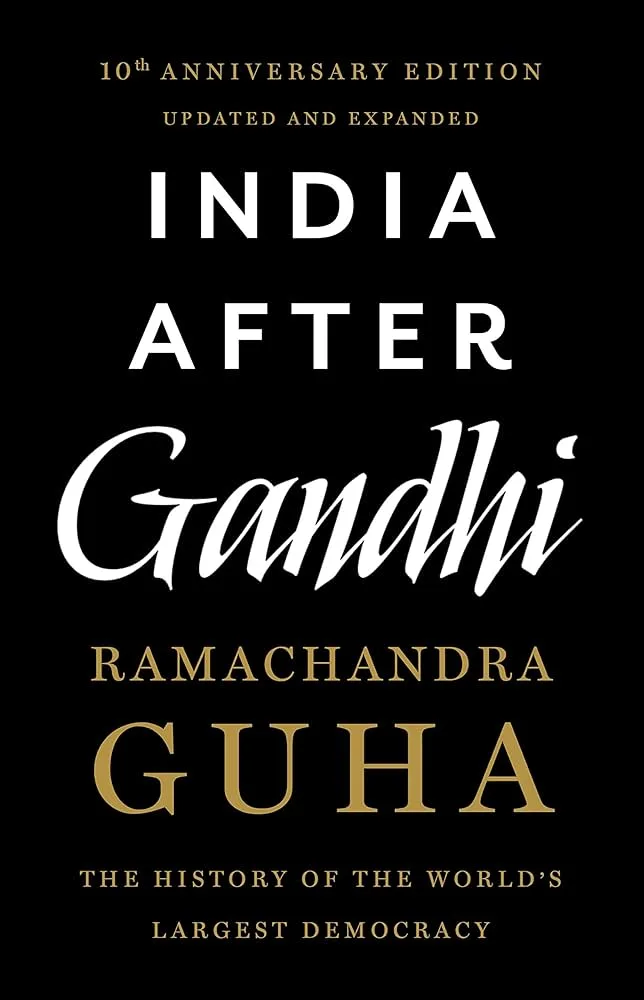
“India After Gandhi,” written by Ramachandra Guha, is a definitive and meticulously researched account of India’s journey after gaining independence in 1947. Published in 2007, this monumental work stands as one of the most thorough and accessible books on modern Indian history. Guha takes readers through India’s political, social, and cultural transformations, offering deep insights into the complexities that have shaped the nation. This article explores the essence of Guha’s work, highlighting its strengths, weaknesses, and why it remains essential for understanding postcolonial India.
Scope and Depth: A Unique Historical Perspective
Unlike many histories that end with the moment of independence, Guha’s narrative begins at the pivotal point of 1947, immediately after the country achieved freedom from British colonial rule. The book spans a period of over six decades, offering a panoramic view of India’s development across the 20th and early 21st centuries. Guha’s scope is expansive—covering not only political events but also social changes, economic developments, and cultural shifts that define modern India.
One of the most significant aspects of the book is the depth of research. Guha draws on an immense array of primary sources, including government records, speeches, interviews, and personal memoirs. This allows him to offer a detailed account of major political events and developments, such as the partition of India, the rise of Nehru’s democratic vision, the emergency imposed by Indira Gandhi, and the challenges of managing a diverse and complex nation. The inclusion of social and cultural narratives makes the book a holistic exploration of India’s post-independence experience.
Balanced and Nuanced Approach
What sets India After Gandhi apart from many other historical accounts is Guha’s balanced and nuanced perspective. He refrains from presenting an overly simplistic view of political leaders or historical events. Instead, he offers a multifaceted analysis, acknowledging both successes and failures without resorting to idealization or vilification. For example, Guha praises Jawaharlal Nehru’s vision of a secular, democratic India but also critically examines his shortcomings, such as his handling of religious tensions and economic policies. Similarly, Guha does not shy away from criticizing Indira Gandhi’s authoritarian rule during the Emergency but also highlights the achievements of her leadership during India’s crucial moments.
This objectivity is vital in a country as diverse and complex as India, where opinions about political figures and events can be deeply polarized. Guha’s even-handed treatment of contentious topics allows readers to form their own opinions based on a comprehensive understanding of the facts. This quality is what makes the book a crucial resource for scholars, students, and anyone interested in India’s democratic experiment.
Strengths of the Book
- Monumental Research: Guha’s work is underpinned by extensive research. He delves into a variety of disciplines, from political science and sociology to economics and cultural studies. This interdisciplinary approach gives readers a complete picture of how India evolved post-independence.
- Clear and Accessible Writing: Despite its scholarly depth, Guha’s writing is accessible to a wide range of readers. He takes complex historical events and makes them comprehensible, without oversimplifying the nuances of each issue.
- Comprehensive Coverage: The book covers a vast range of topics, from the partition of India in 1947 to the rise of Hindu nationalism, economic liberalization in the 1990s, and the challenges posed by global capitalism. Guha’s breadth of coverage ensures that readers gain a well-rounded understanding of India’s trajectory.
- Humanizing History: Through personal anecdotes, interviews, and human stories, Guha brings history to life. The book doesn’t just focus on political events but also on the lived experiences of ordinary people, providing a ground-up perspective on India’s development.
Weaknesses of the Book
- Length and Complexity: At over 900 pages, India After Gandhi can be overwhelming, especially for those who are not accustomed to long historical accounts. Some readers may find the sheer detail and length of the book daunting, especially if they are looking for a more concise narrative.
- Occasional Overload of Information: While the depth of research is a strength, it can also be a weakness. In some places, the book presents a large volume of data, which can sometimes bog down the narrative flow. For casual readers, this information-heavy approach may be challenging.
- Limited Focus on Certain Regions: While the book does a great job covering national politics and key events, certain regions of India, such as the Northeast or Kashmir, receive relatively limited attention. These areas have unique challenges and histories that could have been explored further.
Who Should Read This Book?
India After Gandhi is essential reading for anyone interested in understanding the political, social, and cultural dynamics of post-independence India. It is invaluable for:
- Students of History and Political Science: The book offers a detailed and nuanced understanding of modern Indian history, making it an indispensable resource for students and researchers.
- Politicians and Policy-Makers: Those involved in shaping India’s future can benefit from Guha’s insights into the successes and failures of past policies.
- General Readers with an Interest in India: Whether you are a history enthusiast or someone curious about India’s journey post-independence, this book offers an engaging and comprehensive look at the country’s evolution.
Conclusion
In India After Gandhi, Ramachandra Guha presents a compelling and well-researched narrative of post-independence India. His balanced, insightful approach and extensive research make it an invaluable resource for anyone seeking to understand the complexities of India’s democratic experiment. While the book’s length and detail may overwhelm some readers, its comprehensive nature and fair-minded perspective make it a must-read for those interested in India’s history and development. With its rare blend of depth and accessibility, India After Gandhi remains a seminal work on modern Indian history.
Rating: 4.8/5
Strength: Monumental research and balanced perspective.
Weakness: Lengthy and at times information-heavy.
For more details and to purchase the book, visit India After Gandhi on Amazon.