
Share This Article
Introduction
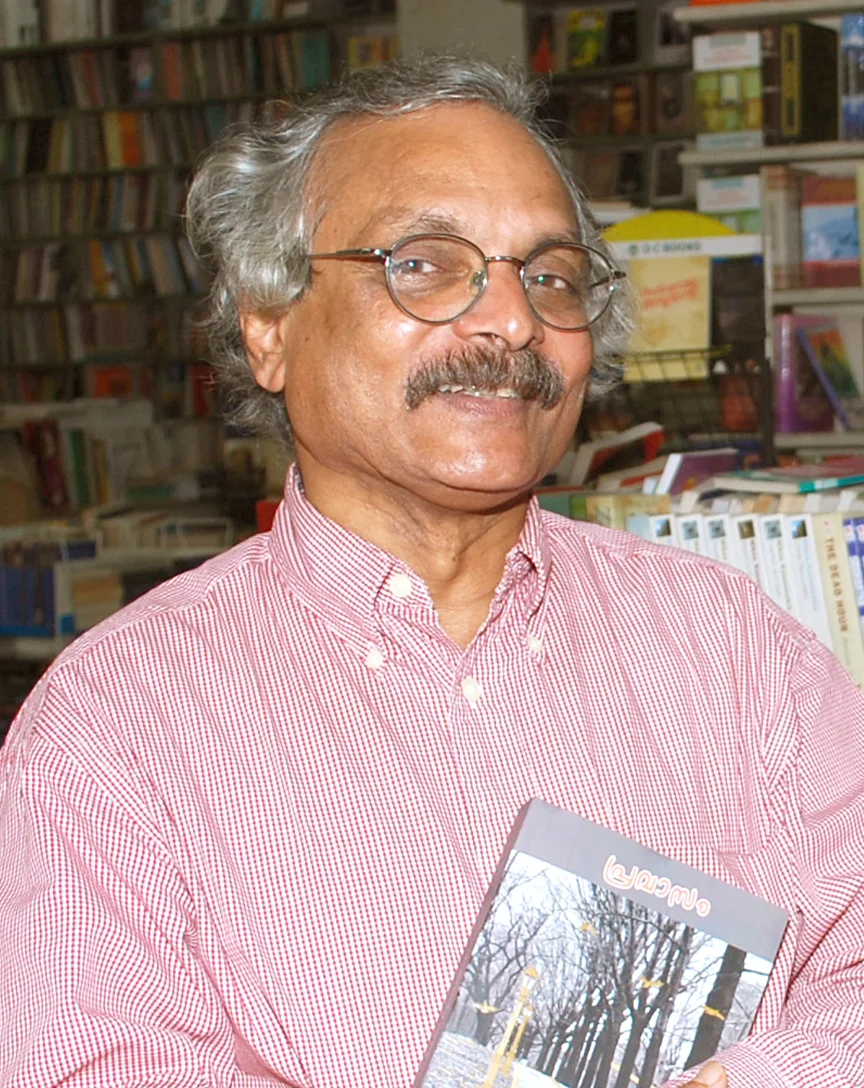
M. Mukundan is a renowned Malayalam novelist celebrated for his insightful portrayals of social change, migration, and urban life in Kerala and beyond. His fiction captures the shifting realities of modern India while preserving the depth and lyricism of Malayalam storytelling traditions.
A pioneering figure in post-independence Malayalam literature, Mukundan’s works often explore how ordinary people navigate displacement, belonging, and identity in rapidly changing worlds. Through his novels, he has emerged as a chronicler of cultural transformation and emotional endurance, making him one of India’s most respected literary voices.
Early Life & Background
Born in Mahe, a small coastal town that was once a French colony in India, M. Mukundan grew up amidst political ferment and cultural diversity. This environment profoundly influenced his worldview, inspiring a lifelong engagement with questions of colonialism, migration, and regional identity.
Mukundan began writing at a young age, deeply inspired by the literary and ideological movements that defined mid-20th-century Kerala. His experiences in Mahe and later in Delhi — where he spent a significant part of his life — provided the social and emotional landscapes that inform much of his fiction.
Writing Journey
M. Mukundan’s literary career spans over five decades and reflects the evolution of Malayalam literature itself. His early works established him as a realist and modernist, while his later novels expanded into urban, psychological, and historical explorations.
One of his most celebrated works, Delhi: A Soliloquy, translated into English in 2021 by Fathima E.V. and Nandakumar K., captures the struggles and resilience of Malayali migrants in Delhi from the 1960s to the 1980s. The novel masterfully intertwines personal narratives with broader social and political transformations, offering a layered portrait of migration and identity.
His earlier classic, Mayyazhippuzhayude Theerangalil (On the Banks of the River Mayyazhi), published in 1974, is regarded as one of the defining works of modern Malayalam literature. It explores the colonial and postcolonial transitions of Mahe through lyrical prose and philosophical depth.
Mukundan continues to write novels, essays, and reflections that document the soul of contemporary India, merging historical insight with profound human empathy.
Published Works
| Title | Year | Genre / Focus |
|---|---|---|
| Delhi: A Soliloquy (English Translation) | 2021 | Migration, urban life, Malayali diaspora |
| Mayyazhippuzhayude Theerangalil | 1974 | Colonial and postcolonial identity in Mahe |
| God’s Mischief | 1992 | Childhood, nostalgia, and the decline of innocence |
| Kesavan’s Lamentations | 1997 | Faith, irony, and self-reflection |
| Pravasam | 2008 | Exile, belonging, and the meaning of home |
Mukundan’s novels, essays, and short stories are widely translated into English and other Indian languages, ensuring his position as a bridge between regional and national literatures.
Writing Style & Themes
M. Mukundan’s writing is known for its lyricism, historical depth, and social awareness. His prose seamlessly blends realism with poetic reflection, and his narratives often oscillate between the personal and the political.
Recurring Themes
- Migration and Displacement: The emotional and cultural challenges faced by individuals moving from rural Kerala to urban India.
- Identity and Belonging: The struggle to find one’s place in a changing world.
- Colonial Legacy: The remnants of European influence on Indian social and cultural life.
- Memory and Modernity: How nostalgia interacts with progress and globalization.
Mukundan’s sensitivity to language, place, and psychology gives his fiction an enduring resonance. His cities and towns are not mere backdrops — they are living, breathing organisms filled with human stories and contradictions.
Achievements & Recognition
- Recipient of the Sahitya Akademi Award for Delhi: A Soliloquy (2021).
- Honored with numerous state and national literary awards for his contribution to Malayalam literature.
- Widely translated into English, French, and other Indian languages.
- Recognized internationally as a major voice in South Asian literature.
- Celebrated for his literary realism and narrative experimentation, which influenced generations of Malayalam writers.
M. Mukundan’s legacy lies in his ability to capture the soul of Kerala’s people and culture, even as his stories extend far beyond its borders.
Beyond Writing
Beyond his fiction, Mukundan is deeply committed to promoting Malayalam literature and mentoring emerging writers. He frequently participates in literary festivals, translation projects, and academic discussions, fostering dialogue between Indian regional literatures and global audiences.
His contributions as a cultural ambassador of Kerala have helped elevate Malayalam writing on the world stage, showcasing the rich diversity of Indian storytelling traditions.
Future Projects
M. Mukundan continues to write novels, essays, and memoirs that reflect on India’s social and cultural transformations. His future works are expected to further explore themes of migration, urbanization, and human resilience, focusing on how individuals navigate change while holding on to their sense of identity.
He also supports translation initiatives, believing that literary exchange is essential for mutual understanding between cultures and languages.
Quotes / Writing Philosophy
“Cities are living organisms; their stories must be told with patience and care.” – M. Mukundan
This quote reflects Mukundan’s philosophy of storytelling. For him, literature is not just about events or characters, but about capturing the pulse of places and people — their growth, decay, and transformation. His writing embodies the belief that the essence of a city lies in the lives of its inhabitants.
Conclusion
M. Mukundan remains one of India’s most profound literary chroniclers, a writer who has given voice to migrants, dreamers, and ordinary lives caught in history’s motion. His fiction stands at the confluence of memory and modernity, bridging Kerala’s cultural roots with India’s urban future.
Through works like Delhi: A Soliloquy and Mayyazhippuzhayude Theerangalil, Mukundan has preserved the emotional and historical landscapes of his time with empathy and precision.
As a novelist, thinker, and mentor, he continues to inspire readers and writers alike — reminding us that every city, every person, and every memory has a story waiting to be told, if only we have the patience and care to listen.